
The two points, what is known as, 'subtend an angle' between them 'at the eye'. (a) in fig 1. This angle is the smallest that the eye can 'resolve' and is the acuity of the eye and is not dependent on distance.
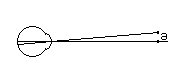
fig 1
When the test was invented over 100 years ago, various sized letters were used at various distances and a normal acuity was decided upon. The test chart was put at 20 feet or 6 metres and the standard size was thus called the '6 metre size'. Meaning that if you could see this letter at 6 metres your acuity was normal.
By varying the distance until the letter was first seen would enable the acuity of any eye to be measured. The worse the acuity, the closer you would have to bring the letter and an eye with higher acuity would be able to see it further away.
This is not practical in routine examination but by fixing the distance and varying the size of the objects, the same result can be reached.
The standard notation for visual acuity is the familiar '20/20' or in this country '6/6'. This means 'the eye can see at 6 metres(20 feet) what the standard eye can see at 6 metres'.
An acuity of 6/12 means 'the eye can see at 6 metres what the standard eye can see at 12 metres' and indicates that the eye is only half as good at resolving two points.
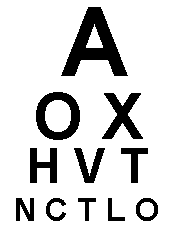
Click on the test chart above to try it out.